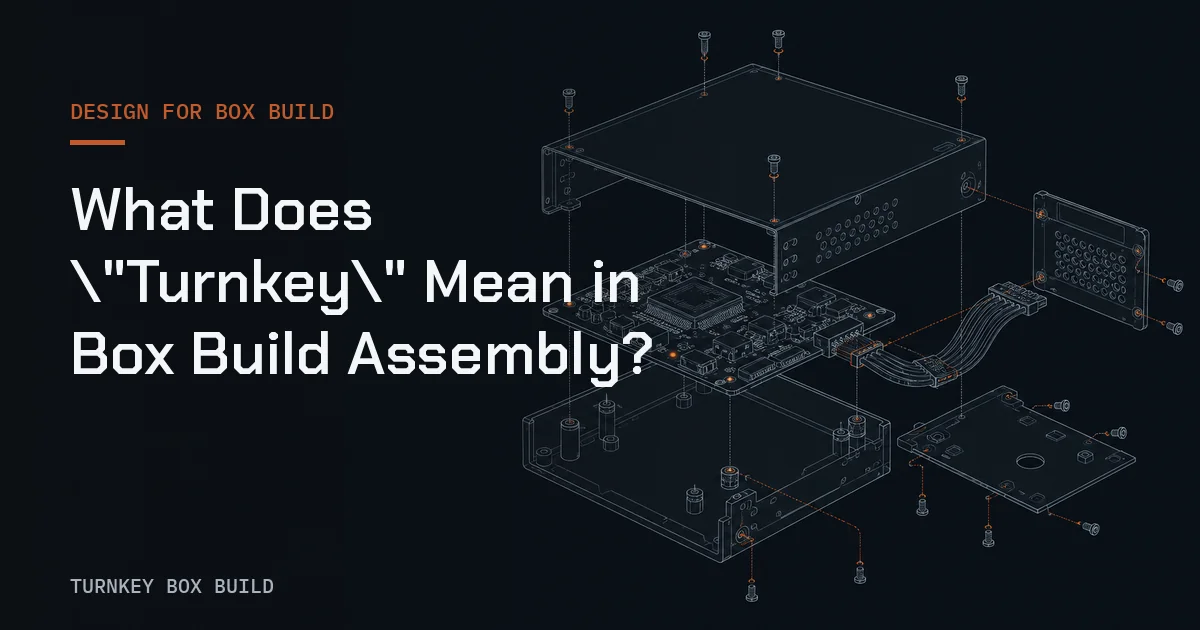
In Box Build assembly, “turnkey” usually means the manufacturing partner coordinates the defined materials, integration steps, tests, documentation, and delivery state under one commercial scope. It does not mean that the supplier owns the product design, may change parts without approval, or performs every contributing process inside one facility. The word is useful only when the quotation explains the responsibility behind it.
OEM teams should treat turnkey as an operating model rather than a marketing label. The model can reduce handoffs, but it also concentrates dependency. A clear responsibility map preserves the convenience without giving up control of revisions, approved sources, acceptance criteria, or product knowledge.
What a turnkey Box Build partner coordinates
A turnkey scope can begin with the released product package and end with a tested, labeled, packaged unit. Between those points, the partner may coordinate approved materials, schedule incoming components, integrate electronic and mechanical subassemblies, load controlled firmware, perform specified tests, retain agreed records, and prepare the final pack-out.
The exact boundary is negotiated. Some OEMs provide critical or constrained items while the partner coordinates the balance. Others retain direct contracts for selected sources. Both are valid turnkey structures if ownership is documented. The capabilities overview shows the integration functions that may be combined into a project scope.
Turnkey does not transfer design authority
Design authority answers who may approve a product change. In most outsourced Box Build programs, that authority remains with the OEM unless a separate design service agreement says otherwise. The integrator can identify a conflict, propose an alternative, or coordinate supplier feedback, but should not silently revise a specification.
That separation protects configuration control. A substitute connector, coating, fastener, firmware file, or label may appear equivalent while changing fit, serviceability, approval status, or field behavior. The OEM should define who reviews deviations, what evidence is required, and how approval connects to the product revision.
Compare responsibility, not labels
Two proposals can both say “turnkey” while covering different work. Normalize the offer against a common matrix.
| Scope element | Questions for the quotation | Evidence to expect |
|---|---|---|
| Material coordination | Which items are included or supplied? | Sourcing assumptions and exclusions |
| Revision control | Which files define the build? | Documented release baseline |
| Integration | Which operations are included? | Routing or work instruction references |
| Testing | Who owns fixtures, limits, and failures? | Approved test plan and records |
| Traceability | What identity follows each unit? | Defined record structure |
| Delivery | What is the final accepted state? | Packaging and shipment specification |
This comparison prevents an apparent price advantage from hiding customer-supplied material, excluded testing, or undefined packaging. A complete Box Build RFQ package guide helps bidders respond to the same baseline.
Material responsibility needs explicit rules
Turnkey sourcing does not remove component governance. The OEM should provide manufacturer information where form, fit, function, lifecycle, or approval status matters. The quotation should identify alternates, customer-controlled sources, long-lead exposure, and the process for handling unavailable items without promising an unsupported schedule.
The partner should also state how incoming material is accepted and how nonconforming inputs are contained. If an OEM supplies material, the parties still need rules for count discrepancies, transit damage, revision mismatch, excess disposition, and replacement responsibility. These details belong in the commercial scope because they affect both cost and schedule.
Test ownership is often the real boundary
Turnkey delivery is credible only when “finished” has a measurable definition. The OEM normally owns product requirements and acceptance intent. The integrator can convert those inputs into controlled execution, connect fixtures, run tests, capture results, and manage failed-unit routing.
For many products, test development is a separate engineering scope. The OEM should provide limits, expected states, interfaces, known-good references, safety precautions, and diagnostic guidance. The functional testing capability describes how approved procedures can be integrated into the manufacturing flow. It should never be assumed that a generic power-on check proves product performance.
Documentation determines whether control scales
Turnkey programs depend on a coherent release baseline: bill of materials, drawings, models, assembly instructions, firmware, test specifications, labels, packaging, and revision history. If those items conflict, the integrator needs a defined query and approval route before proceeding.
Record requirements deserve the same precision. Decide what must be stored, in what format, for how long, and how records relate to unit or batch identity. Do not ask for “full traceability” without naming the fields and retrieval need. A vague requirement creates cost without assuring that the captured data will answer a future question.
Commercial terms that deserve attention
The purchasing agreement should address tooling ownership, inventory liability, authorized buys, forecast handling, engineering changes, cancellation exposure, nonconformance disposition, warranty boundaries, and end-of-program material. These are not boilerplate details. They determine how risk moves when design or demand changes.
Quantities should be evaluated by project. The useful discussion covers expected demand pattern, release method, configuration mix, and material commitment. Avoid forcing a universal production model onto a product whose design maturity or demand is still changing.
When turnkey is the wrong choice
Turnkey Box Build may be a poor fit when the product definition changes daily, the OEM cannot provide acceptance criteria, or critical supplier relationships must remain directly controlled. A partial or staged model can be safer: begin with controlled integration of customer-supplied inputs, stabilize the process, then transfer additional coordination responsibility.
It is also reasonable to keep sensitive firmware, regulated decisions, or strategic components outside the turnkey boundary. The goal is not to maximize outsourced scope. It is to create an accountable operating model that matches the OEM’s risk posture.
How to request a meaningful turnkey quote
Define the product structure, annual demand assumptions, variants, supplied items, approval rights, test intent, records, packaging, and final delivery state. List every known gap. Ask bidders to return assumptions and exclusions in the same structure so engineering and procurement can compare like with like.
For the broader definition, see what Box Build assembly includes, and use Box Build vs contract assembly to choose the right commercial boundary. Then submit the package through request a quote. End the sourcing cycle with a scope review so responsibilities are agreed before material or schedule commitments begin.
A credible turnkey proposal maps every included operation to the Box Build process and states how revisions, incoming material, test results, deviations, and release records fit the quality and traceability framework. Any item outside that map should remain an explicit OEM, supplier, or approved third-party responsibility.