Mechanical platform
Enclosure, panels, mounting features, hardware, access and fit requirements.
Complete-Unit Integration
Combine mechanical hardware, electronics, controls and wiring in a revision-controlled product assembly.
Request a quote
Send your drawing, BOM or idea — we reply with a practical Box Build scope review.
Electromechanical assembly connects prepared subassemblies to the complete Box Build. We coordinate the enclosure, mounted electronics, internal interconnects, controls, power items and purchased hardware so their interfaces are built and checked under one defined scope. The deliverable may be a complete product or a documented subsystem, depending on the customer-approved boundary.
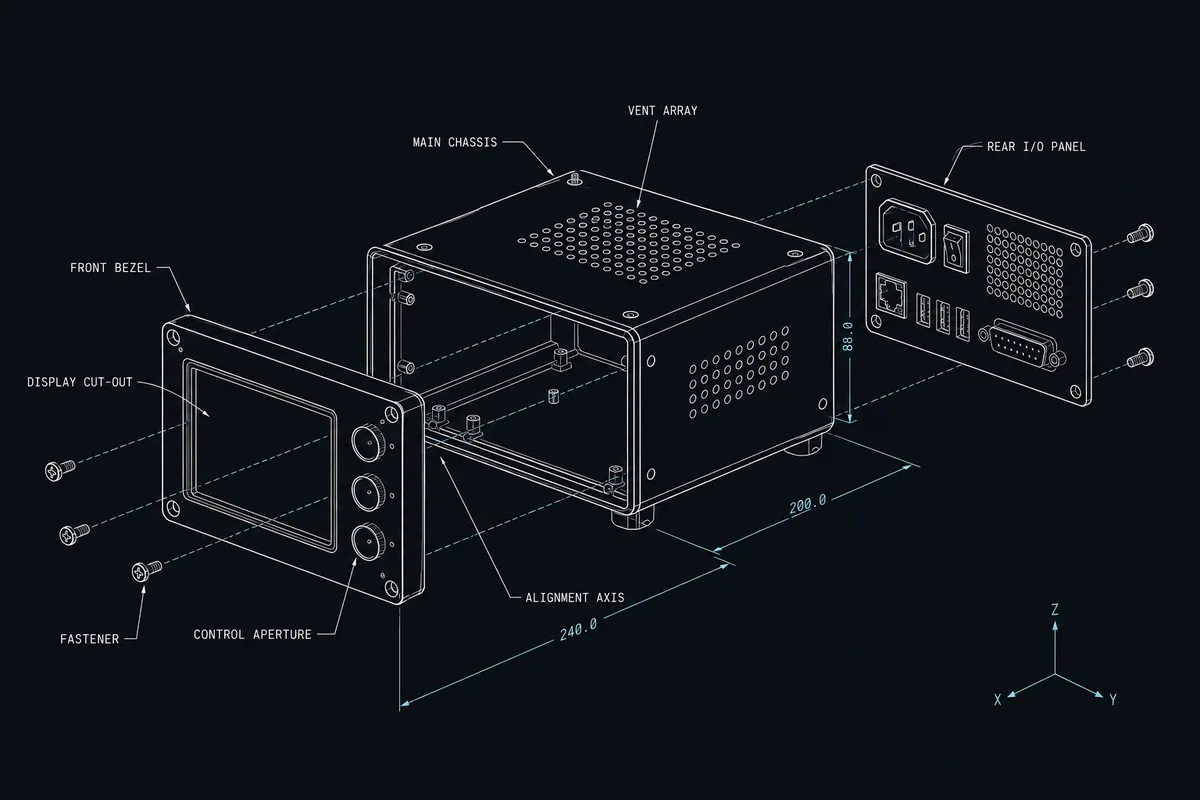
The released BOM and drawings can combine brackets, panels, switches, displays, fans, power components, PCBAs, internal harnesses, connectors, labels and other specified items. We identify customer-supplied and coordinated inputs, then control their status before the unit enters assembly.
Enclosure, panels, mounting features, hardware, access and fit requirements.
Approved boards, power items, controls and internal harness routing.
Build order affects tool access, cable routing, connector seating and the ability to inspect critical features. We use the pilot or first controlled unit to verify the practical sequence. Interface reviews cover tolerance stack-up, grounding points, polarity, connector access, cable protection, serviceability and access for later test operations.
Approved drawings, BOM revision, fastening requirements, cable routes, inspection points and reference images can be brought into a version-controlled instruction. The instruction should show what an operator must do and what an inspector must confirm, including variant-dependent steps.
A change to a bracket, PCBA, harness, firmware release or label may affect sequence and test. We identify affected documents and the first units built to the new configuration before release.
We execute customer-approved system checks after the required assembly and configuration steps. Depending on the product, the procedure may address power-up, indicators, controls, I/O, motion, sensors or communication behavior. Coverage and pass or fail criteria are never assumed. They are defined with the test revision, interface method, limits and result-record requirements.
Failures are held, reviewed and reworked only through the agreed authorization path. See functional testing for Box Builds.
BOM, assembly drawings, enclosure CAD and interface requirements.
PCBA, harness, controls, power items, hardware and supply responsibility.
Assembly sequence, fastening, routing, inspection and special handling.
Firmware, configuration, test procedure, limits, fixtures and result format.
Labels, serial rules, accessories, packaging, records and delivery condition.
Product stage, variants, build quantities, forecast and approval contacts.
A pilot build provides a controlled place to validate fit, route, access, work instructions, fixtures and the customer approval path. Variant matrices then connect the applicable BOM, firmware, labels, accessories and tests. Engineering changes update that baseline through an agreed effective point rather than informal substitution on the line.
Have a BOM, assembly drawings, enclosure CAD, harness requirements or test procedure? Send what you have. We’ll confirm the Box Build scope, identify missing information and outline the next step before quotation.

Send your drawing or idea and we’ll reply with a practical Box Build scope review.