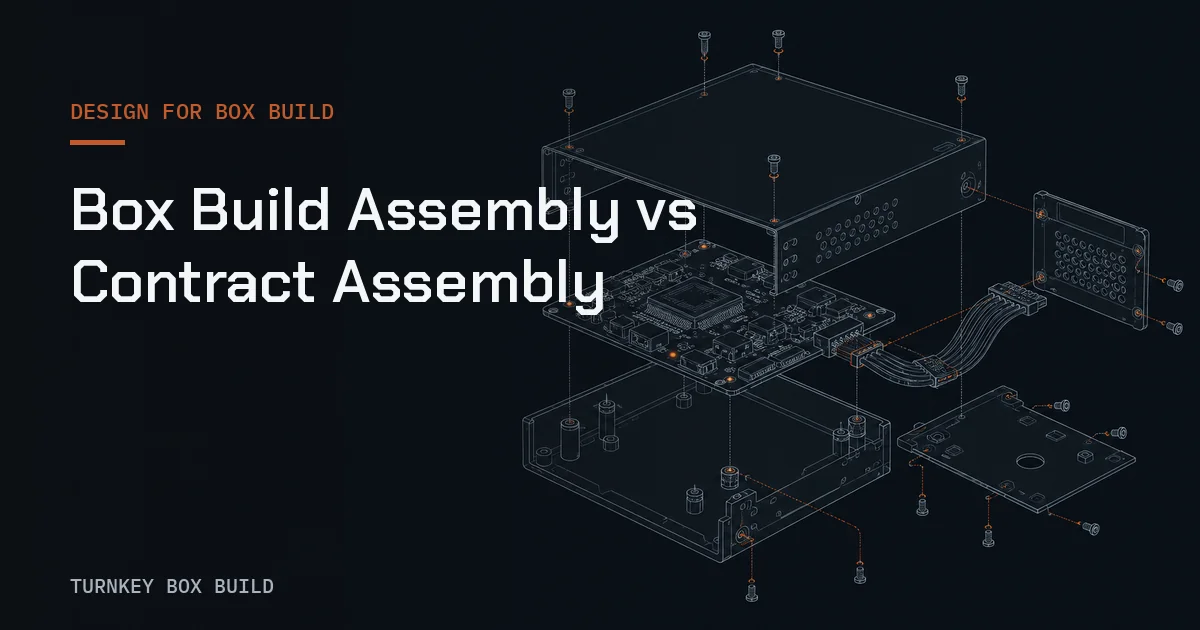
Box Build assembly describes the product-integration work; contract assembly describes the commercial arrangement under which an outside organization performs defined manufacturing work. A contract assembler can provide Box Build, and a Box Build program is usually contracted, but the terms are not interchangeable. One names the deliverable scope, while the other names the outsourcing relationship.
OEM buyers should separate those ideas before requesting quotations. Otherwise, one bidder may price labor against customer-supplied kits while another prices coordinated materials, testing, documentation, packaging, and finished-product delivery.
Define the two terms by responsibility
Contract assembly is outsourced manufacturing performed to an agreed specification. Its scope may be narrow or broad: a mechanical subassembly, a cable installation, an electromechanical module, or a complete unit. Box Build assembly is specifically the integration of electronic, electrical, and mechanical elements into a product or higher-level subsystem.
The capabilities overview shows how integration activities combine. What Box Build assembly includes goes deeper into the parts, documentation, tests, and delivery state that distinguish finished-product work from an isolated operation.
Why the difference affects quotations
A request for “contract assembly” tells a bidder that work is outsourced but does not define what enters or leaves the process. A request for “Box Build” gives more product context, yet it still does not state sourcing responsibility, design authority, test coverage, records, or packaging.
The RFQ must name both the commercial model and the physical deliverable. State which inputs the OEM supplies, which the partner coordinates, what constitutes acceptance, what evidence accompanies each unit or batch, and how changes are approved.
Compare common operating models
| Model | Typical input | Typical output | Main OEM responsibility |
|---|---|---|---|
| Labor-focused contract assembly | Complete controlled kit and instructions | Assembled item | Material availability and kit accuracy |
| Managed contract assembly | Mixed supplied and partner-coordinated inputs | Accepted subassembly | Approved-source and change decisions |
| Box Build integration | Product package and defined components | Tested product or subsystem | Product definition and acceptance intent |
| Turnkey Box Build | Released package with coordinated sourcing scope | Configured, documented delivery | Design authority and approval governance |
These models overlap. The table is a conversation tool, not a fixed industry classification. A proposal should explain its actual boundary rather than rely on a label.
Material ownership changes risk
In a customer-supplied model, the OEM retains direct material control but also owns shortages, revision mismatch, transit damage questions, and kit completeness. In a coordinated model, the manufacturing partner manages approved purchasing within agreed rules, while the OEM still controls substitutions that may affect product requirements.
Neither structure is universally better. Customer supply can fit strategic or constrained items. Partner coordination can reduce handoffs and consolidate scheduling. A hybrid often works well when the responsibility matrix identifies each material family and the commercial treatment of unused, excess, or obsolete inventory.
Design authority should remain visible
Outsourcing assembly does not automatically outsource product design. The manufacturer can review manufacturability, flag conflicts, and suggest alternatives. The OEM should approve any change affecting the released definition unless a separate agreement grants broader design responsibility.
A controlled technical query process is essential. It should connect the issue, affected revision, proposed disposition, approver, effective unit or build, and updated documentation. Verbal approval at a workstation cannot support later configuration control.
Test scope separates simple labor from delivery accountability
Contract assembly may end with workmanship inspection, while Box Build often includes product-level functional acceptance. The distinction must be written. A power-on observation, continuity check, and functional sequence answer different questions and require different fixtures, instructions, limits, and records.
The functional testing capability outlines how approved test requirements can become a controlled production step. The OEM owns product intent and acceptance logic; the integrator can execute, record, and route failures. Test development should be identified separately when no approved method exists.
Documentation sets the practical boundary
Narrow contract work may run from a drawing and work instruction. Box Build generally needs a connected release package: product hierarchy, mechanical data, system connections, firmware, variants, labels, tests, packaging, and traceability fields. The more responsibility a partner coordinates, the more important revision alignment becomes.
Ask how the provider receives releases, confirms readiness, controls station instructions, handles redlines, and closes changes. Certified manufacturing systems may support document control, but the project still needs specific ownership and evidence.
When contract assembly is the better description
Use a narrower contract assembly scope when the OEM wants to preserve direct material control, the work package is stable and self-contained, or the deliverable is clearly a subassembly that does not require product-level configuration or acceptance. This can keep responsibilities simple when internal teams manage the remaining integration.
It is also a sensible starting point for an immature product. The parties can stabilize instructions and interfaces before shifting a larger sourcing or finished-delivery scope.
When Box Build is the better fit
Use Box Build when the value lies in coordinating interactions among boards, enclosures, wiring, controls, firmware, labels, tests, and packaging. A Box Build scope can reduce organizational handoffs because one flow owns the configured delivery state.
The model is strongest when acceptance is defined and product data is sufficiently mature. If the term “turnkey” is under consideration, read what turnkey means in Box Build assembly before assigning responsibility.
Write the RFQ around outcomes
Describe incoming material state, assembly operations, customer and supplier responsibilities, acceptance tests, records, nonconformance routing, change approval, packaging, and delivery. Ask bidders to list assumptions and exclusions against the same headings. This makes commercial differences visible.
Use the RFQ checklist to assemble the source package and the request-quote page when it is ready. If the choice between contract assembly and Box Build remains unclear, request a scope review so the quotation matches the delivery outcome you actually need.
One practical test is to compare the proposed responsibility boundary with the site’s Box Build process and the representative product categories under what we build. The label matters less than whether every required operation, approval, record, and delivery condition has a named owner.