Menu

What We Build

Energy Storage / BESS Enclosure Box Build Assembly

Integrate the approved enclosure, power-conversion electronics, control boards, internal wiring and busbars, interfaces and verification into a defined finished energy-storage unit — built to your released design.

  • Cabinet, power-conversion and control integration
  • Project-defined power-up and I/O checks
  • Serialized and documented handover

Request a quote

Request a Box Build Scope Review

Send your drawing, BOM or idea — we reply with a practical Box Build scope review.

Need technical help instead? Contact support

What Energy Storage / BESS Enclosure Builds Usually Involve

An energy-storage or battery-energy-storage-system (BESS) enclosure brings the approved cabinet or rack housing, mounting frame, approved power-conversion modules and PCBAs, battery-management and control boards, contactors, disconnects and protection devices, busbars, high-current harnesses, terminals, metering, ventilation or thermal provisions, and the external power and communication interfaces into one controlled assembly. The product definition determines which elements are customer-supplied and which we coordinate. Our role is to integrate the approved inputs, verify the finished unit against your acceptance plan and deliver it in the agreed condition — the battery cells and modules and their handling requirements are defined and owned by the customer.

The assembly sequence matters because access narrows as rails, boards, power devices, busbars, cooling paths and high-current harness branches are installed. A build plan should keep fastening, connector mating, torque, grounding and bonding, sealing, inspection and service access possible without forcing parts or hiding required checks. It is closely related to how we handle power control systems, EV charging station enclosures and industrial control boxes.
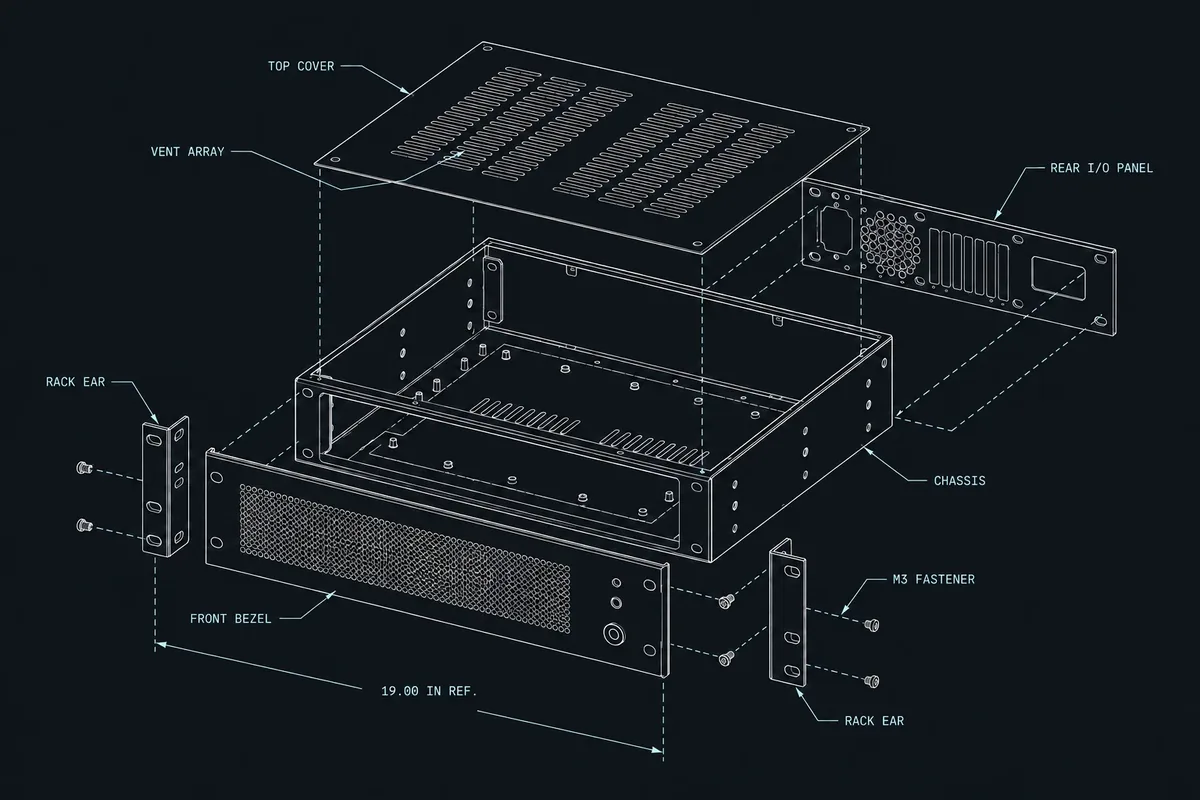

Exploded rack-cabinet enclosure blueprint showing the chassis, top cover, vent array, front bezel, rear I/O panel and rack-mount ears

Typical Integration Scope

Enclosure and mechanical platform

We prepare the approved indoor or outdoor cabinet or rack and internal mounting structure, then install rails, brackets, panels, seals, glands, grounding hardware and cable-entry provisions. Cutouts, ingress sealing for the rated environment, ventilation or cooling openings, and door and service-access clearances are checked as part of enclosure integration.

Power-conversion electronics and protection

Approved power-conversion modules, inverter or PCS boards, BMS and control PCBAs, contactors, disconnects, breakers, protection devices, metering, busbars and terminals are installed to the released assembly definition. Mounting, isolation, creepage and clearance presentation, thermal contact and access are coordinated through PCBA integration and electromechanical assembly — to the design you provide, not one we specify.

Internal interconnections, busbars and high-current wiring

Power and signal harnesses and busbar links follow the approved connection map, with attention to conductor and busbar sizing per print, torque and joint preparation, bend radius, separation, strain relief, retention, sharp edges, heat sources, grounding and bonding. Connection and polarity checks are defined with the harness integration scope.

Configuration and final delivery

Where required, approved firmware or device parameters are loaded and recorded. Unit labels, serial identity, warnings, accessories, manuals and protective packaging are applied according to customer-approved files before the finished assembly is released.

Engineering and Verification Considerations

Review focuses on the interfaces that affect assembly repeatability and finished-unit behavior. Requirements are not inferred from the product category — they must be defined by the drawings, specifications and customer-approved acceptance plan.

Layout, clearance, thermal, sealing and environment

The design should identify electrical clearances and creepage, grounding and bonding points, busbar torque and insulation, ventilation or thermal-management paths, the ingress-protection rating and sealing for indoor or outdoor use, orientation, mounting method and any environmental constraints. Product-level BESS safety, battery cell and module safety, and system certification — for example UL 9540, UL 1973, IEC 62619 and applicable fire and installation codes — remain the customer's responsibility and are separate from assembly verification; they should be assigned in the responsibility matrix.

Finished-unit test

A project may require defined power-up behavior, voltage, isolation and continuity observations, grounding checks, indicators, controls, communications or selected I/O checks. The functional-test package must state setup conditions, fixtures, limits, expected responses, pass or fail rules, data capture and the process for failures, rework and retest.

For a new or changed design, an NPI or pilot build can expose access, routing, busbar, sealing, thermal, sequence and test issues before repeat production. Approved findings feed back into the BOM, drawings, work instructions and verification package.

What to Include in the RFQ

Send the current product definition and mark preliminary information clearly. The most useful package explains both the physical build and the evidence required at handover.

Product and material definition

BOM, approved sources, quantities, variants, assembly drawings, enclosure or cabinet CAD, environmental and IP rating, ventilation or cooling details, busbar drawings and a list of customer-supplied items including battery cells or modules.

Electrical and software inputs

Connection diagrams, power-conversion, BMS, PCBA and harness revisions, conductor and busbar sizing, torque values, grounding and bonding requirements, firmware, configuration values and programming access.

Verification and compliance boundary

Inspection criteria, functional-test procedure, fixtures, acceptance limits, required records and clear ownership of product-level BESS safety and certification activities.

Identity and delivery

Serial rules, label artwork, accessories, manuals, packaging, delivery condition, build quantity, forecast and requested timing.

Use the complete Box Build RFQ checklist or return to all product types.

Ready to Review Your Box Build Scope?

Have a BOM, assembly drawings, enclosure CAD, harness requirements or test procedure? Send what you have. We’ll confirm the Box Build scope, identify missing information and outline the next step before quotation.