Stable, Repeatable Volume Production
High-Volume Box Build Manufacturing
Move a proven product onto a fixtured, balanced line with released instructions, in-process controls and unit-level records that hold quality and delivery steady at scale.
- Fixtured, balanced line
- In-process controls
- Planned material supply
Request a quote
Request a Box Build Scope Review
Send your drawing, BOM or idea — we reply with a practical Box Build scope review.
When a Product Is Ready for High-Volume Box Build
A product is ready for volume when the design is released and stable, the BOM is frozen with approved sources, the test and acceptance criteria are defined and repeatable, and there is a real forecast to plan against. High-volume production earns its efficiency from repeating a settled process, not from discovering one — so readiness is judged from design maturity, material status, verified assembly steps and change control, not from a headline quantity alone. Where those inputs are still moving, the right first step is a controlled ramp rather than a full volume line.
What Changes from Low-Volume to Volume Production
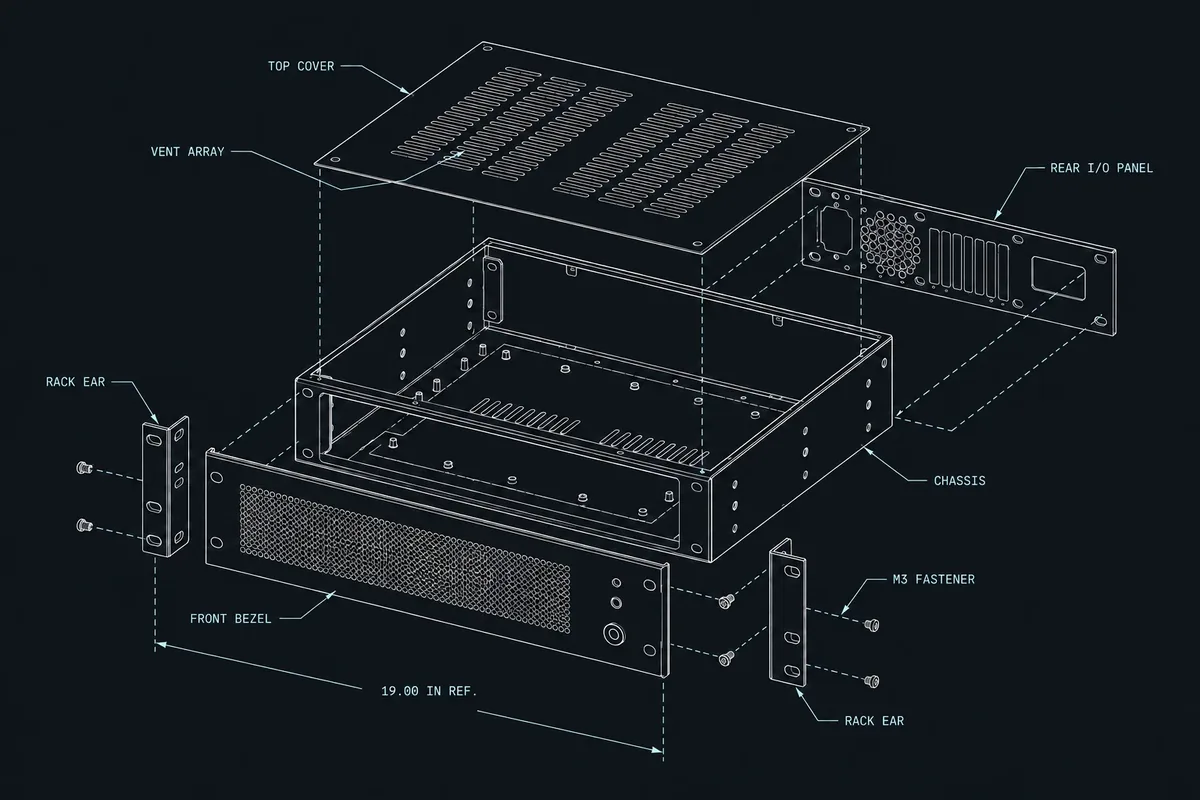
At volume the work shifts from flexible, instruction-led assembly to a balanced, tooled line. Recurring operations move onto fixtures and jigs so each unit is built the same way; the sequence is balanced across stations to hold a steady cycle time; process windows for fastening, board mounting, harness routing and closure are tightened and monitored; and operators work to standardized instructions with defined training. A build that is still changing configuration frequently often fits low-volume, high-mix production better until the design settles.
Process Control and Consistency at Scale
Consistency at volume comes from controlling the process, not inspecting quality in at the end. Version-controlled work instructions fix the assembly order and reference points; a first-off check confirms the current configuration before a run proceeds, and a last-off check confirms nothing drifted; in-process inspection sits at defined points rather than only at the end; and key characteristics are monitored so a shift is caught as a trend, not as a batch of failures. Defects are captured, contained and connected to the affected units so containment is bounded.
Material Planning and Supply Continuity
Volume production is only as steady as its material supply. We plan releases against the forecast, hold agreed buffers on long-lead items, and draw from approved sources and customer-supplied inputs against the released build. End-of-life and shortage risks are flagged so an approved alternate is qualified before it stops a line, and incoming material is checked for identity, quantity and revision before it reaches the floor. The scheduling and control detail sits on our production process page.
Continuity before the line, not during
Forecast-driven release, buffered long-lead parts, approved alternates and incoming checks keep a scheduled run from stalling on a missing part.
Test, Serialization and Traceability at Volume
Each unit or batch can carry its functional test result, serial, label and packaging status to the depth and data format agreed for the program. Serialization ties a unit back to its build configuration and material, and authorized rework and retest stay connected to the release decision rather than disappearing into a pass count. This keeps a volume program auditable without slowing the line.
From NPI and Pilot to Volume Ramp
Volume works best as the last step of a maturity path, not the first. A new or materially changed product should pass through NPI and pilot production first, where the instructions, fixtures, test coverage and cycle time are proven on a small run. Issues found and closed at pilot are inexpensive; the same issues found at full rate are not. Once the pilot is stable, the ramp scales the same proven process rather than a new one.
Managing a Multi-PO Volume Program
Volume delivery is a scheduling discipline as much as an assembly one. On one program, an Asia-Pacific robotics OEM ran a product rollout as a multi-purchase-order program with split deliveries against a tight schedule. When one of the split POs came under timeline pressure, proactive order management carried the day: the constrained PO received an early delivery-timeline warning while the remaining POs were confirmed on schedule, and payment and release status were communicated the same day. The result was a program that kept schedule transparency and customer trust across every PO instead of surfacing a delivery dispute at the end. That visibility is what separates a volume relationship that renews from one that does not.
Volume, Forecast and RFQ Inputs
Send annual forecast, planned batch sizes, product mix and variants, revision status, expected fluctuation and target timing together with the complete product files. Volume fit and pricing are evaluated with the assembly content, material exposure, test depth and delivery cadence for the specific product, not from quantity alone.
Prepare the technical package
Include BOM, drawings, enclosure, PCBA and harness inputs, firmware, test, labels, packaging and supply responsibility.
Review the capability map
Check which integration, configuration, verification and final-delivery activities belong in scope.
Ready to Review Your Box Build Scope?
Have a BOM, assembly drawings, enclosure CAD, harness requirements or test procedure? Send what you have. We’ll confirm the Box Build scope, identify missing information and outline the next step before quotation.