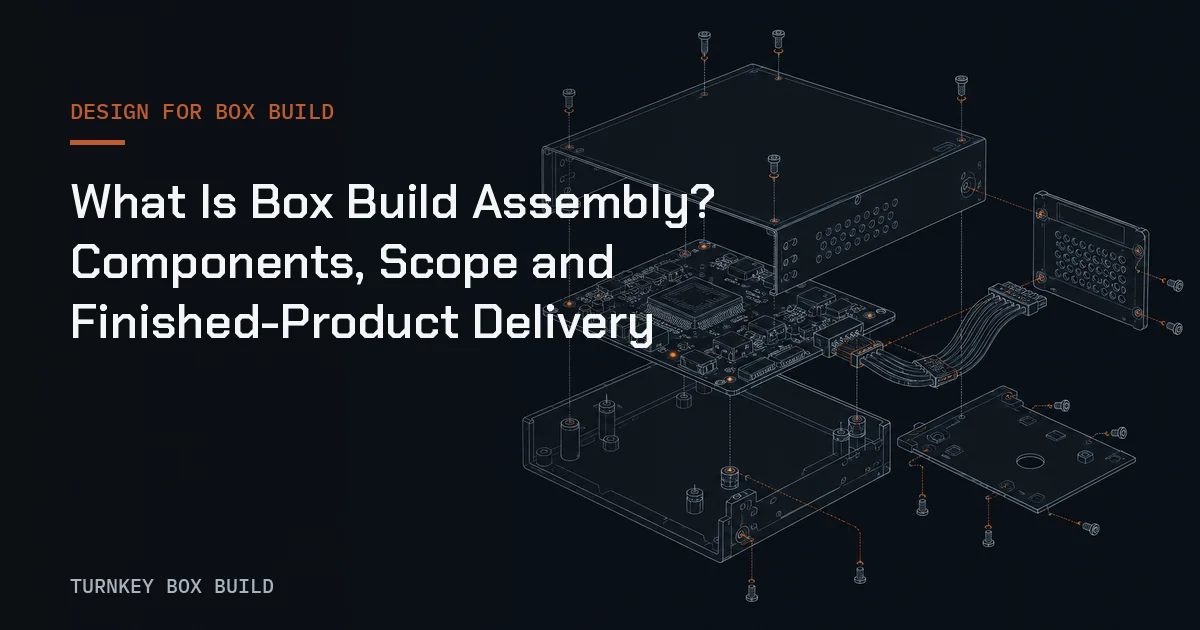
Box Build assembly is the controlled integration of electronic, electrical, and mechanical parts into a deliverable product or subsystem. The work may begin with approved assemblies and end with a configured, tested, labeled, packed unit. For an OEM, the important question is not whether a supplier can install parts in an enclosure. It is whether every interface, acceptance rule, and handoff is defined well enough to produce the intended finished product repeatedly.
That broader responsibility is why Box Build decisions affect engineering, procurement, quality, and logistics at the same time. A good scope removes gaps between those functions before a quotation is issued.
What belongs in a Box Build scope?
A Box Build scope should describe everything the manufacturing partner must integrate, verify, document, and deliver. Typical inputs include an enclosure, approved PCBAs, cable assemblies, switches, displays, fans, power components, fasteners, labels, and packaging. These items are mentioned here only as elements of the integrated product; each may come from an approved source chosen by the OEM or coordinated by the integrator.
The scope can also include firmware loading, configuration, cosmetic inspection, functional testing, serialization, accessory kitting, and shipment preparation. Our Box Build capabilities overview explains how these activities connect. The boundary should be explicit: supplied material, sourced material, controlled substitutes, customer-furnished fixtures, and third-party processes all need named owners.
Box Build is more than final assembly
Final fastening is only one part of the job. The real value lies in managing interfaces that can fail even when every individual component meets its own drawing.
| Integration area | OEM decision to document | Manufacturing output |
|---|---|---|
| Mechanical fit | Datums, torque method, finish protection | Correct alignment and secure assembly |
| Electrical connection | Pin mapping, polarity, routing limits | Verified interconnection |
| Thermal path | Interface material and placement | Controlled contact and airflow path |
| Configuration | Firmware, settings, variant rules | Correct product identity |
| Acceptance | Test limits and defect criteria | Recorded pass or disposition |
| Delivery | Labels, accessories, pack-out | Shipment-ready unit |
This interface view distinguishes Box Build from a loose collection of outsourced operations. It also explains why enclosure details deserve early attention; the enclosure integration capability covers the mechanical handoffs that often drive rework.
Where board-level work ends
Board-level assembly produces an electronic assembly that has its own documentation and inspection criteria. Box Build begins when that assembly must interact with the product around it: mounting points, cables, chassis grounding, controls, displays, firmware, airflow, and external connectors. The distinction is explored in Box Build assembly vs PCBA assembly.
The boundary can vary by program. An OEM may supply fully accepted PCBAs, or ask the Box Build partner to coordinate them as controlled inputs. Either arrangement can work. What matters is that incoming acceptance, nonconformance ownership, revision control, and test responsibility are written into the scope rather than assumed.
Turnkey does not mean undefined
Turnkey Box Build usually means the manufacturing partner coordinates more of the supply and delivery chain, but it does not remove OEM decisions. Approved specifications, design authority, change approval, and product acceptance still need clear owners. Read what turnkey means in Box Build assembly before using the term in an RFQ.
The safest commercial model is a responsibility matrix. Put every material family, document, process, inspection, test, record, and delivery item in one row. Assign who provides the input, who performs the work, who approves a deviation, and what evidence closes the task. That matrix prevents two suppliers from pricing different interpretations of the same sentence.
Documents that make the product buildable
A useful release package connects product definition with execution. At a minimum, it should contain:
- a hierarchical bill of materials with approved part information;
- mechanical drawings and models with revision alignment;
- assembly instructions for sequence-sensitive work;
- cable and interconnect information within the integrated unit;
- firmware and configuration rules by product variant;
- labeling, serialization, and packaging artwork;
- inspection and functional test requirements;
- deviation, change, and record-retention expectations.
The RFQ checklist gives procurement and engineering a shared way to review those inputs. Missing documents do not always prevent a quotation, but the supplier should state assumptions and exclusions so uncertainty is visible.
How finished-product delivery changes procurement
Buying a finished product changes the unit of acceptance. Procurement is no longer receiving separate parts that other teams will reconcile later. It is receiving a product that must match a defined variant, carry the right identity, pass the agreed tests, include the correct accessories, and survive the specified distribution path.
Commercial comparisons therefore need more than a unit price. Compare material responsibility, test coverage, tooling ownership, exception handling, packaging, traceability, and change control. A lower quote may simply exclude work that another bidder has included. Normalize those boundaries before deciding which offer is genuinely comparable.
What Box Build does not automatically include
No capability should be inferred from the phrase alone. Environmental qualification, regulatory evaluation, custom test development, field installation, product design ownership, and lifecycle support are separate scope items unless the quotation includes them. A supplier may coordinate qualified external resources without representing every process as an in-house operation.
The same caution applies to certified manufacturing systems. The OEM should request the documentation relevant to its project and verify that the proposed production route matches the required controls. Box Build integration does not by itself establish a product-level compliance conclusion.
A practical sourcing decision
Box Build is a strong fit when an OEM wants one accountable integration flow from controlled inputs to a tested, shipment-ready unit. It is less useful when the design is still undefined, acceptance criteria are unavailable, or the OEM needs to retain direct control of every separate operation. In those cases, a staged engagement can close design and documentation gaps before production responsibility expands.
Start by defining the delivery state in plain language: what arrives, what leaves, what evidence travels with it, and who approves exceptions. Then use the request-quote path to send the available package. For a focused next step, request a scope review so we can identify integration boundaries and RFQ gaps before pricing.
In a typical integration map, an accepted board enters the PCBA integration flow while prepared cables and harnesses enter the cable-harness integration flow. The actual Box Build route must still define the incoming condition, installation sequence, inspection, and failure handling for each project.