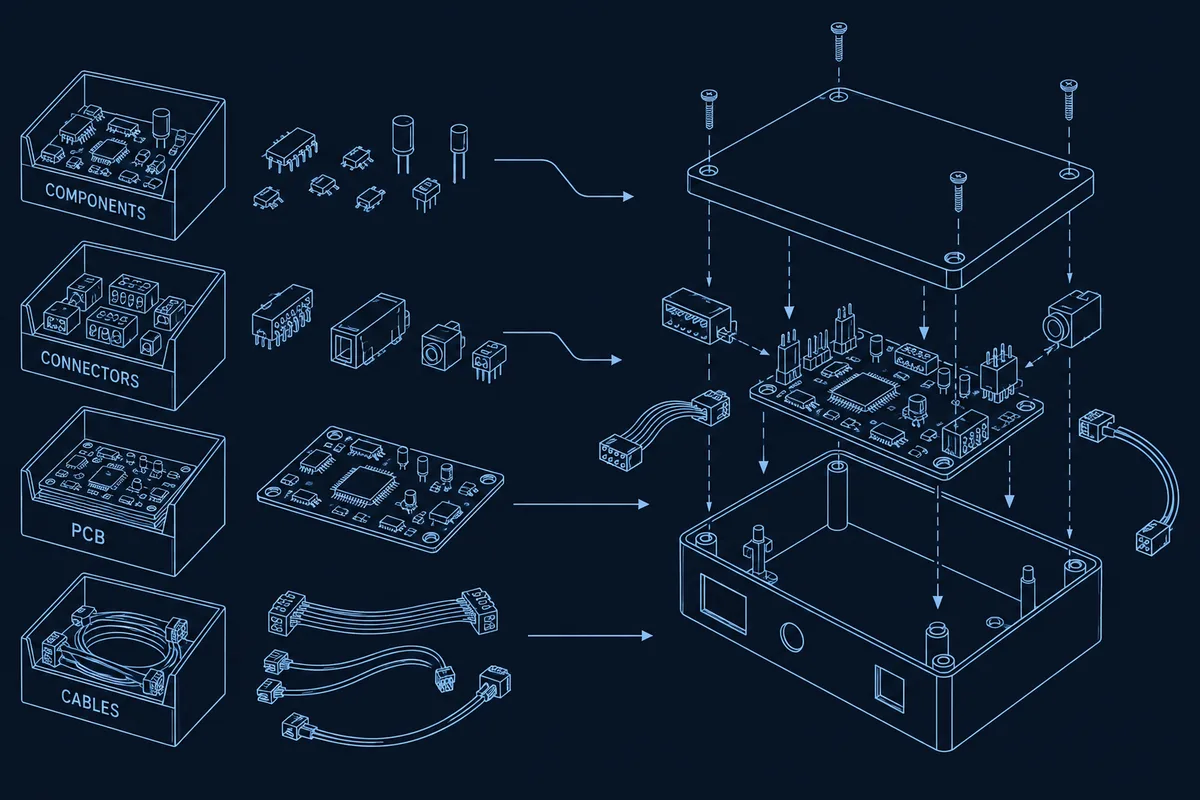
In Box Build assembly, the material-supply model decides one thing above all: who buys the parts. Under a turnkey model, the manufacturing partner sources and purchases the defined materials and delivers a finished, tested unit under one commercial scope. Under a consignment model, the customer buys some or all of the parts and supplies them to the partner, who assembles. Most real programs land somewhere between the two. The right split is a business decision, not a default: it turns on who has the better prices and supply access, who should carry the inventory risk, and how much direct control and traceability the OEM needs.
This guide compares the two models on responsibility, cost, lead time, inventory risk, quality traceability, and control, then gives a decision guide and the terms to pin down whichever way you go. It is written for OEM engineers and buyers structuring a Box Build program, not choosing a vendor yet — that comes later, in how to choose a Box Build manufacturer.
The two models in one line
- Turnkey — the partner sources, buys, and builds. You release a package; you receive tested units. This is the “one throat to choke” model, and it relies on a clear responsibility map, which the guide on what “turnkey” means in Box Build breaks down.
- Consignment — you buy the parts and supply them; the partner assembles and tests. You keep price and source control; the partner is paid for the work, not the materials.
- Partial turnkey — you consign a few critical, long-lead, or IP-sensitive parts and let the partner turnkey the rest. In practice this middle path is the most common.
Turnkey vs consignment at a glance
| Dimension | Turnkey | Consignment |
|---|---|---|
| Who sources and buys | The manufacturing partner | The customer (OEM) |
| Inventory / excess risk | Mostly the partner | Mostly the customer |
| Price leverage | Partner’s buying power and spend pooling | Customer’s own contracts and pricing |
| Lead-time coordination | One party owns the whole material timeline | Split across parties; kitting must align |
| Single point of accountability | Yes — one owner for the material set | No — shared between buyer and builder |
| Source / revision control | Delegated (must be documented) | Retained directly by the customer |
| Admin overhead for the OEM | Lower | Higher (POs, expediting, kitting) |
| Best when | You want fewer handoffs and one owner | You have better prices, access, or IP control |
When turnkey makes sense
Turnkey wins when you want a single accountable owner for the material set and less procurement overhead, and when the partner’s buying power and supply access are better than yours for most of the BOM. Consolidating sourcing under one partner removes handoffs, shrinks the number of suppliers the integration team manages, and shortens the path from released package to shipped unit.
As a representative example, an industrial-machinery OEM had been running separate suppliers for its wire harnesses and its PCB assemblies — the fragmented supply and integration mismatches that split sourcing tends to create. Consolidating both under a single manufacturing partner turned what had been five-figure, single-category orders into a broader multi-category program, with one partner coordinating the materials from the microcontrollers and boards through to the harnesses. The gain was not primarily a lower unit price; it was fewer handoffs and one accountable owner for the whole material set. That is the core turnkey argument.
When consignment makes sense
Consignment wins when you hold advantages the partner cannot match on specific parts. Common reasons to consign:
- Better pricing or contracts. You have negotiated pricing or a corporate agreement on key components that beats what the partner can buy at.
- Long-lead or allocated parts you already control. You are holding, or can secure, a constrained part — an MCU on allocation, a specialty connector — and want to protect the build slot with your own stock.
- IP-sensitive or custom parts. Custom silicon, proprietary modules, or controlled items you do not want a third party to source.
- Direct source control. You want to keep approved sources under your own contracts rather than delegate them.
The trade is more administrative work — purchase orders, expediting, and kitting that has to arrive complete and on time — and inventory and obsolescence risk that sits with you rather than the partner.
Partial turnkey: the common middle
Most mature programs are not purely one or the other. The OEM consigns the handful of parts where it has a real advantage — long-lead, allocated, IP-sensitive, or specially priced — and lets the partner turnkey the rest. This captures the cost or control benefit on the parts that matter while keeping the convenience and single-owner accountability of turnkey everywhere else. The one rule: document ownership line by line on the BOM, so no part falls into the gap between “I thought you were buying that.”
Whichever route you choose, mark it on every BOM line; the box build BOM preparation guide shows how.
What to pin down either way
Whichever model you choose, settle these before the first build:
- BOM ownership per line — mark each part as customer-supplied or partner-sourced; leave nothing ambiguous.
- Excess and obsolescence risk — who owns leftover stock, minimum buys, and end-of-life parts.
- Incoming inspection — who inspects consigned parts, and how a defective consigned part is handled versus a partner-sourced one.
- Kitting and shortage handling — how a missing part is flagged and resolved without silently substituting.
- Traceability — how consigned versus bought parts are recorded, so traceability survives the split.
- Price transparency — for turnkey, how material cost is shown in the quote so you can still benchmark it.
Get those into the RFQ package and the model becomes a clean commercial choice rather than a source of disputes later. For the wider set of integration functions a partner may coordinate, see the capabilities overview.
FAQ
What is the difference between turnkey and consignment in Box Build? Turnkey means the manufacturing partner sources and buys the materials and delivers finished, tested units; consignment means the customer buys the parts and supplies them to the partner, who assembles. Turnkey concentrates accountability and reduces the OEM’s procurement work; consignment keeps price and source control with the OEM.
Which is cheaper, turnkey or consignment? Neither is automatically cheaper. Turnkey can be cheaper when the partner’s buying power beats yours and the reduced handoffs save overhead; consignment can be cheaper when you have better pricing or contracts on key parts. Compare the total delivered cost, including your own procurement and inventory carrying effort, not just the part prices.
Who carries inventory risk in each model? In turnkey, the partner mostly carries inventory and excess risk; in consignment, that risk sits with the customer. Long-lead and minimum-order-quantity parts are where this matters most, so decide who owns leftover and obsolete stock up front.
What is partial turnkey? Partial turnkey is a mix: the customer consigns a few critical, long-lead, or IP-sensitive parts while the partner turnkeys the rest. It captures a cost or control advantage on the parts that matter while keeping single-owner convenience elsewhere. Document ownership line by line on the BOM.
Can I consign only the long-lead parts? Yes — that is a common partial-turnkey arrangement. You supply the constrained or allocated parts you already control and let the partner source the rest. Agree on how your consigned stock is received, inspected, and reconciled against the build so a shortage or a defect is handled cleanly.