Scope-summary prompts
- What is the finished unit and what stage is it in?
- Which inputs are supplied by the customer?
- What must be assembled, verified and documented?
- What quantity, variants and delivery condition are required?
RFQ Readiness for Complete Assemblies
Bring the mechanical, electrical, software, test and delivery inputs into one review package. You can send incomplete information first; we will identify the gaps that matter before a reliable quotation or build release.
Request a quote
Send your drawing, BOM or idea — we reply with a practical Box Build scope review.
01 / Product and boundary
Begin with a short description of the finished product, its current development stage and the condition in which it must be delivered. Identify what you expect us to coordinate, integrate, test, document and package.
Include the target build quantity or forecast, planned variants, decision owners and any known exclusions. A concise scope summary gives the detailed files a shared context.
02 / Material definition
Send the current BOM revision with manufacturer part numbers, descriptions and quantities per unit. Include the approved vendor list or substitution rules where purchasing choices are controlled.
Mark the released or working revision and identify options, alternates and variant-specific quantities.
Separate customer-supplied items from material you want us to coordinate, including consigned spares.
Flag long-lead, constrained or end-of-life items and state who may authorize substitutions.
03 / Mechanical definition
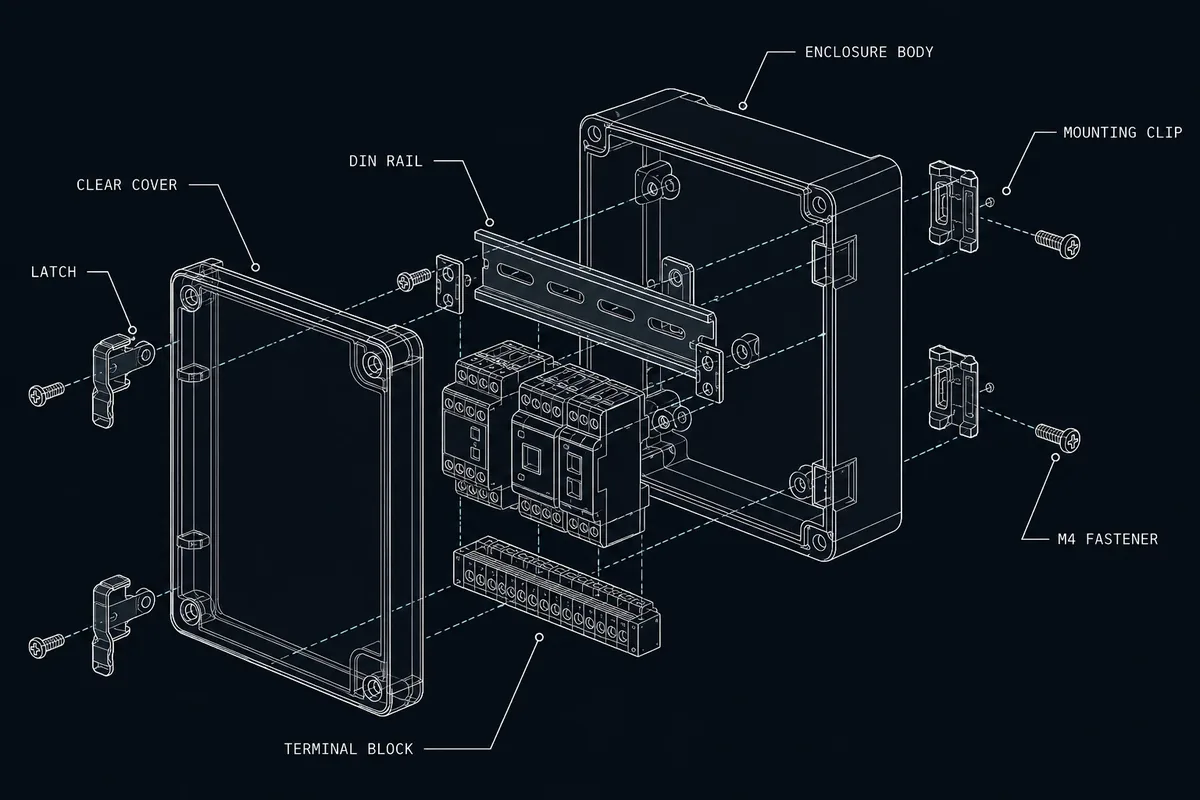
Provide the overall assembly drawing, exploded views and enclosure CAD where available. Dimensioned drawings should identify mounting points, cutouts, panel and connector locations, clearances and critical external interfaces.
Add torque or fastening requirements, seals, thermal interfaces, grounding provisions, cosmetic criteria and special process notes that affect integration.
04 / Electrical interfaces
For PCBA integration, provide the approved board outline, mounting scheme, keep-outs, connector locations, grounding and thermal requirements, and any access needed for programming or test. The purpose is to define how the board fits and functions inside the Box Build.
For cable harness integration, include the drawing or connection definition, connector identity, route and retention requirements, branch lengths, labels, polarity, shielding or grounding provisions, strain relief and allowed service loops.
05 / Controlled verification
Provide the approved firmware image or controlled access method, version rules, device settings and configuration values. State how a successfully configured unit should be identified.
The test package should define the procedure revision, fixture and interface responsibilities, setup conditions, limits, expected results, pass/fail logic, retest or failure handling and required data retention.
Review finished-unit functional testing06 / Finished-unit presentation
Supply the serial-number rules, label artwork, approved content and placement drawings. Identify product labels, regulatory artwork supplied by the customer, tamper or warning labels and any carton or pallet identification.
List manuals, cables, adapters, fasteners and other accessories packed with each unit. Define protective materials, orientation, inner and outer packaging, packing quantities and shipment-specific requirements.
Review labeling, serialization and packaging07 / Records and control
Define the required first-article review, incoming and in-process checks, acceptance criteria, deviation workflow and engineering-change authority. State which records must connect to a unit, batch or shipment.
Describe the final documentation package: for example, an approved serial list, inspection or test results, configuration status, deviation references, accessory check and packing list. Required outputs should be agreed before the build starts.
Define quality and traceability expectations08 / Send what you have
You can start with incomplete BOMs, preliminary drawings, partial test notes or a list of known decisions. We will organize the available inputs, separate confirmed requirements from assumptions and identify the missing information that blocks quotation or build release.
Early scope review is useful, but critical mechanical, electrical or acceptance data must be resolved before we can make reliable production commitments.
See how NPI planning turns open questions into controlled build learning
Send your current BOM, drawings, enclosure CAD, harness information and test requirements. We will identify missing inputs and define the next review step.

Send your drawing or idea and we’ll reply with a practical Box Build scope review.