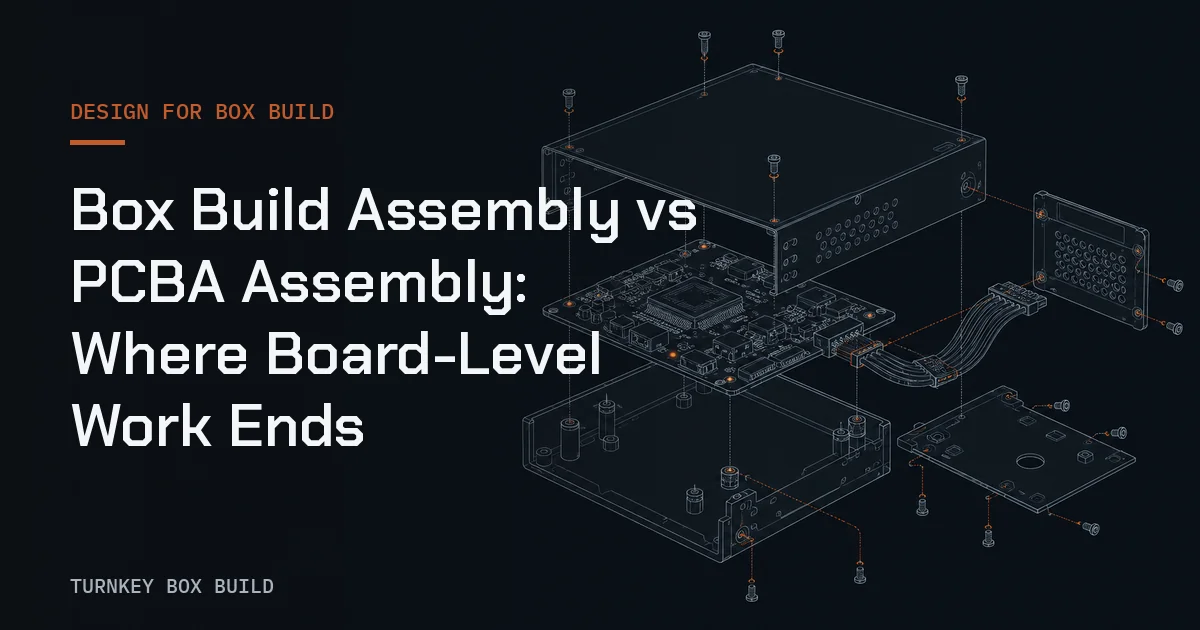
PCBA assembly creates the populated board; Box Build assembly integrates that board into the product or higher-level subsystem that an OEM intends to receive. The boundary sounds obvious until a quotation leaves grounding, cable routing, firmware, fastening, testing, labels, or packaging unassigned. Those gaps appear between drawings, departments, and suppliers rather than inside a single process.
For sourcing teams, the choice is rarely PCBA or Box Build. It is a decision about where board-level acceptance ends, where system-level responsibility begins, and who manages the interface.
The simplest distinction
A PCBA is an electronic assembly built on a printed circuit board. Box Build is a product-integration scope that may use one or more accepted PCBAs together with enclosures, cables, controls, power elements, displays, thermal parts, labels, and packaging. Those component categories are relevant here only as inputs to the finished assembly.
The PCBA integration capability focuses on receiving, handling, mounting, connecting, and verifying boards within the larger unit. It does not imply that every board-level or upstream process is performed by the same organization.
Where board-level work should end
The handoff should occur at a documented acceptance state, not at a vague departmental boundary. An accepted PCBA may have completed the inspection and electrical checks specified for the board. Box Build then controls how that board is installed, connected, configured, and tested in its product environment.
The OEM must decide whether board failures discovered during system integration return to a board supplier, enter a joint diagnostic flow, or remain under one coordinated commercial scope. Without that decision, the Box Build line becomes an unplanned troubleshooting station and defect ownership becomes contentious.
Scope comparison for OEM buyers
| Decision area | PCBA assembly scope | Box Build assembly scope |
|---|---|---|
| Primary deliverable | Accepted populated board | Accepted product or subsystem |
| Mechanical datum | Board drawing and panel constraints | Enclosure, bracket, interface datums |
| Electrical boundary | Board-level nets and interfaces | Connected product behavior |
| Firmware | May be programmed at board level | Correct image and configuration by variant |
| Test focus | Board acceptance | Functional behavior of integrated unit |
| Identification | Board revision or assembly identity | Finished-product serial and label set |
| Packaging | Board protection | Product accessories and distribution pack-out |
Neither scope is inherently more rigorous. Each must have appropriate requirements. The difference is the object being controlled and accepted.
Mechanical interfaces become product requirements
A board can meet its drawing and still fail to fit the product. Connector alignment, standoff height, keep-out zones, fastener access, cable bend space, grounding contact, and thermal-interface compression all emerge at Box Build level. Tolerance interaction matters more than any isolated dimension.
OEMs should provide the enclosure model, board model, mounting hardware, datum scheme, and installation sequence together. The electromechanical assembly capability shows how mechanical and electrical interfaces are coordinated during integration. When models and drawings disagree, the release package should state which source governs.
Test intent changes after integration
Board-level tests answer whether the PCBA meets defined board requirements. Box Build tests answer whether the connected product performs the functions selected for manufacturing acceptance. A final test may check power states, controls, indicators, communications, sensors, interlocks, or configured options, but the OEM must define the expected behavior and limits.
System testing should not become an undefined substitute for product validation. Validation establishes whether the design meets its intended use; manufacturing acceptance checks whether a production unit matches the approved design under the agreed method. Keeping those purposes separate prevents a pass result from being interpreted too broadly.
Documentation must connect both levels
The board and product release packages need common identifiers. At minimum, connect the PCBA part number and revision to the finished-unit variant, firmware, test program, label, and bill of materials. If a board revision is compatible with only some product configurations, that rule belongs in controlled documentation.
Useful handoff records may include incoming acceptance status, board identity, deviation references, installed unit serial, firmware checksum or controlled identifier, test outcome, and rework disposition. Capture only what the OEM can govern and retrieve. More fields do not create better traceability when definitions are unclear.
Common commercial gaps
Procurement teams should challenge these ambiguous phrases:
- “tested assembly” without named test coverage;
- “complete unit” without accessories or packaging definition;
- “firmware included” without file ownership and revision rules;
- “all materials included” without customer-supplied and approved-source boundaries;
- “traceable” without record fields and retrieval expectations;
- “ready to ship” without the final destination or pack-out specification.
The RFQ checklist turns these phrases into specific questions. A bidder should return assumptions where the source package does not yet provide an answer.
One partner or separate partners?
One coordinated partner can reduce handoffs and give the OEM a single route for material, integration, and delivery issues. Separate specialists can preserve direct control, provide flexibility, or suit products whose board and final-assembly supply chains operate independently. The right structure depends on design maturity, internal engineering capacity, approved-source strategy, and the cost of managing interfaces.
If separate partners are used, define incoming acceptance at the Box Build site and a failure-analysis loop involving both parties. If one partner coordinates the scope, define how upstream defects, substitutions, and changes remain visible to the OEM. Commercial simplicity should not erase technical accountability.
Decide from the required delivery state
Start with what procurement needs to receive. If the deliverable is an accepted populated board, a PCBA scope may be sufficient. If it is a configured enclosure, instrument, controller, cabinet subassembly, or shipment-ready product, the work belongs in a Box Build scope.
Review what Box Build assembly includes and Box Build vs electromechanical assembly to refine that boundary. You can then submit the package for quotation. Ask for a scope review first if board-level and product-level responsibilities are still mixed across documents.
When the PCBA becomes an input to enclosure integration, its mounting, grounding, connector access, thermal interfaces, and protection requirements become part of the product route. Capture that handoff explicitly in the Box Build process so board acceptance and finished-unit acceptance are not confused.