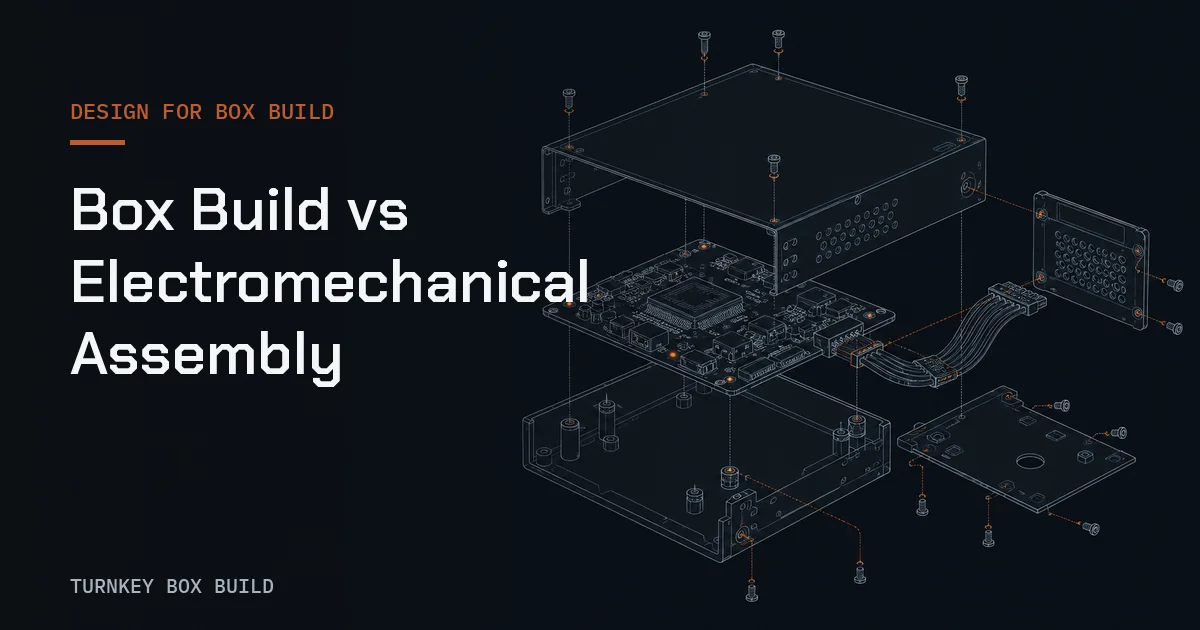
Electromechanical assembly combines electrical and mechanical parts into a functioning assembly; Box Build usually extends that integration to a defined product or shipment-ready subsystem. The terms overlap because many Box Builds are electromechanical. The useful distinction is the delivery boundary: a mounted and connected module may be electromechanical assembly, while a configured, tested, labeled, and packaged unit is more clearly Box Build.
OEMs should not choose a label first. They should define inputs, output state, acceptance, and ownership, then use the term that best communicates the scope.
What electromechanical assembly covers
Electromechanical assembly focuses on the relationship between electrical functions and mechanical structure. Within an integrated product, that can include mounting switches, relays, displays, power components, fans, sensors, connectors, PCBAs, cables, brackets, and protective hardware. The work depends on fit, routing, fastening, grounding, motion clearance, and reliable connection.
The electromechanical assembly capability describes how these interfaces are coordinated. The provider may integrate approved inputs and coordinate qualified external support without representing every upstream process as internal.
What makes a scope Box Build
Box Build adds a product-level definition around the assembly. It connects component integration with configuration, functional acceptance, product identity, documentation, accessories, packaging, and delivery. The enclosure may be a simple housing, rack chassis, controller cabinet, console, or another mechanical structure defined by the OEM.
What Box Build assembly includes explains this broader boundary. A project does not need every possible activity to qualify as Box Build. It needs a clearly defined higher-level deliverable whose interfaces are controlled as one unit.
Side-by-side scope comparison
| Decision area | Electromechanical assembly | Box Build assembly |
|---|---|---|
| Core purpose | Combine electrical and mechanical parts | Deliver a defined product or subsystem |
| Common endpoint | Connected functional module | Configured and accepted unit |
| Enclosure role | Structure or part of the assembly | Part of the controlled product definition |
| Test boundary | Assembly-specific checks | Product-level manufacturing acceptance |
| Configuration | May be limited | Usually tied to product variants |
| Identification | Part or subassembly identity | Finished-unit labeling and serialization |
| Packaging | Protective handling | Defined accessories and delivery pack-out |
The table describes common patterns, not a rulebook. A sophisticated electromechanical module can have more demanding controls than a simple Box Build. Scope and risk determine rigor.
Mechanical details decide electrical success
Electrical problems often originate in mechanical interfaces. A shifted connector opening can prevent full engagement. Poor cable routing can load a termination. Inconsistent thermal contact can change device behavior. Finish buildup can affect grounding contact, while inaccessible fasteners can make a correct sequence impossible.
OEMs should release models and drawings with common revisions, identify governing datums, define critical interfaces, and include installation sequence where access changes during assembly. The enclosure integration capability provides a framework for fit, hardware, grounding, sealing, thermal paths, and cosmetic protection.
Product configuration widens the boundary
Electromechanical work may build one fixed assembly. Box Build frequently manages product variants that share mechanical parts but differ in board revision, cable set, firmware, label, accessory, or regional configuration. The release package needs rules that connect each orderable product to the correct controlled inputs.
A configuration matrix should identify valid combinations and effective revisions. It should also state how rework, firmware update, or approved deviation changes the finished identity. Without that logic, individually correct parts can form the wrong product.
Test purpose must be defined
An electromechanical check may verify continuity, motion, actuation, or an interface. A Box Build functional test normally evaluates selected behavior of the integrated unit under an approved production method. Neither should be called “complete testing” without named coverage and limits.
The OEM owns intended behavior and acceptance criteria. The integrator can help turn those requirements into executable instructions, run the tests, record results, and route failures. Design validation, safety evaluation, and regulatory assessment remain separate unless explicitly included and governed by appropriate authority.
Sourcing models can be the same
Both scopes can use customer-supplied, partner-coordinated, or hybrid material. The word Box Build does not automatically mean turnkey, and electromechanical assembly does not automatically mean labor-only. Material responsibility belongs in a line-level matrix.
For each input, define approved sources, substitution authority, incoming acceptance, shortage handling, excess disposition, and change notification. Review Box Build vs contract assembly to separate the physical deliverable from the commercial outsourcing model.
Documentation scales with the delivery state
An electromechanical subassembly may be governed by a bill of materials, drawings, connection data, and work instructions. A Box Build package often adds firmware, product variants, functional test, labels, serial rules, accessories, packaging, and shipment records. All documents should share a controlled release baseline.
The supplier should identify contradictions before work begins and return assumptions in the quotation. Certified manufacturing systems can support document control, but they do not replace project-specific release ownership or acceptance definitions.
Which term should an OEM use?
Use “electromechanical assembly” when the deliverable is a defined module whose key challenge is combining mechanical structure and electrical function. Use “Box Build” when the supplier must manage the unit as a product-level configuration through test, identity, documentation, packaging, and delivery.
If both descriptions fit, use both and remove ambiguity with a scope statement. For example, define the project as electromechanical integration within a Box Build delivery scope, then list the exact inclusions and exclusions.
Prepare the sourcing package
Provide product hierarchy, models, drawings, connection information, approved parts, assembly requirements, configuration rules, test intent, labels, traceability fields, packaging, and delivery state. Ask the supplier to identify design gaps and commercial assumptions rather than pricing silent interpretations.
The RFQ checklist organizes these inputs, and the request-quote page provides the submission path. If the boundary between module assembly and finished product remains uncertain, request a scope review so the RFQ names the correct output and accountable owner.
At either scope level, define the handoffs between PCBA integration and cable-harness integration instead of treating electrical content as one undifferentiated task. Their workmanship criteria, incoming states, connection checks, and failure routes may differ even when both are installed in the same enclosure.