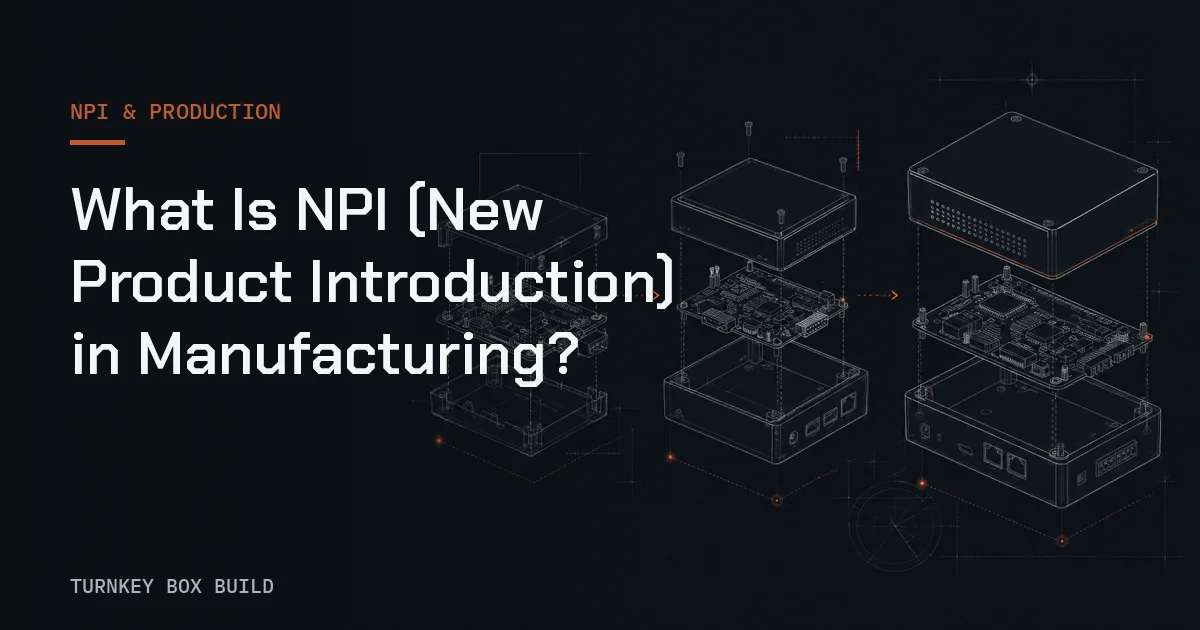
New Product Introduction, or NPI, is the controlled process that turns a product definition into a repeatable manufacturing system. For Box Build, that system includes the released product data, approved materials, assembly route, tooling, work instructions, configuration, testing, traceability, packaging, and ownership needed to build and release the product.
NPI is not a synonym for prototype assembly. A prototype may answer a narrow design question, while NPI proves that people can follow controlled inputs and produce usable evidence. The process ends only when open risks have an approved disposition and the organization authorizes the intended production state.
What problem does NPI solve?
Engineering documents describe a product, but production needs a coordinated operating system. A drawing may define a bracket while leaving the assembly sequence unstated. A test specification may define expected behavior without identifying the fixture, configuration, data fields, or failure route. NPI connects those pieces.
The practical goal is to discover mismatches before repeat production amplifies them. Those mismatches may involve design, material, tooling, instructions, access, configuration, test, records, packaging, or responsibility. NPI does not guarantee that no issue will occur; it creates a disciplined way to find, classify, resolve, and retain learning.
Who participates in NPI?
NPI requires decisions from more than manufacturing engineering. Product engineering owns design intent and approved changes. Quality defines acceptance, exceptions, and required evidence. Procurement and supply-chain owners address approved sources and material risk. Operations defines the production route, training, and capacity assumptions. Test and software owners control configuration and verification assets. The firmware loading and configuration capability illustrates one workstream that needs explicit revision and ownership rules.
The Box Build partner contributes manufacturability review, sourcing coordination within the agreed boundary, route development, controlled execution, and issue feedback. Responsibility should be written rather than inferred. What turnkey means in Box Build assembly explains how sourcing scope changes ownership without transferring product authority.
What inputs should be ready?
An NPI team needs a product baseline: bill of materials, models, drawings, schematics, cable and connection data, approved sources, firmware, configuration rules, labeling, test requirements, and packaging expectations. Each input needs an owner and revision status.
Preliminary data can support planned learning, but the team must distinguish it from a released production baseline. The Box Build RFQ package guide offers a structured way to identify missing inputs before quotation and kickoff. Unknowns should become visible actions, not silent assumptions inside a schedule or price.
What happens during NPI?
The exact route depends on product risk and maturity, but the decision flow is consistent.
| NPI activity | Main question | Controlled output |
|---|---|---|
| Scope review | What is being delivered, and who owns each decision? | Responsibility matrix |
| Design review | Can the product be assembled and verified as defined? | Issue register |
| Material planning | Are sources, substitutions, and supplied items controlled? | Material plan |
| Process development | What sequence, tools, and instructions are required? | Manufacturing route |
| Test readiness | Are configuration, limits, fixtures, and data approved? | Released test package |
| Pilot execution | Does the proposed system work under controlled conditions? | Build evidence and issues |
| Release review | Are blockers closed and residual risks owned? | Production authorization |
These activities may overlap. The key is to preserve entry criteria, outputs, and approval ownership rather than force every product into an identical calendar.
How does DFM fit into NPI?
Design for manufacturing is one workstream inside NPI. Box Build DFM reviews mechanical, electrical, thermal, test, service, labeling, and packaging interfaces before they become station problems. It should identify design changes and process clarifications separately.
Read the DFM guide for Box Build assembly for the review framework. A DFM issue is not closed by conversation alone; closure should point to an approved document change, verified process decision, or accepted risk owned by the proper authority.
What is a pilot build meant to prove?
A pilot build tests the proposed manufacturing system against explicit learning objectives. It may confirm assembly access, sequence, fixture fit, instruction clarity, configuration selection, traceability, failure handling, test flow, or packaging. The team chooses the build scope from the questions that remain open, not from a universal quantity rule.
Pilot units should move through controlled inputs and record issues at the station. Temporary instructions or deviations need approval and a route into released documentation. The existing Box Build NPI process describes how to plan and control that transition.
How should NPI issues be managed?
Every issue needs classification, containment, owner, due decision, affected documents, and closure evidence. Classifying the source matters: a product design issue calls for design authority, while a work-instruction ambiguity may belong to manufacturing engineering. Material, tooling, test, software, and quality-system issues require different owners.
Teams lose learning when corrections remain in meeting notes or technician memory. Update the governing drawing, bill of materials, instruction, fixture, script, or acceptance document. Then verify the correction where the issue occurred.
What makes an NPI release decision credible?
A credible release is evidence-based and specific to the intended production state. The review should confirm product data, material readiness, route, tooling, instructions, training, configuration, test, traceability, packaging, and exception handling. Open items should be closed or assigned an approved residual-risk owner.
Certified manufacturing systems can support document and change discipline, but they do not replace product-specific readiness. A successful pilot also does not authorize repeat production if its corrections have not entered controlled documents.
What should buyers request from an NPI partner?
Ask prospective partners to describe their NPI deliverables, review inputs, issue-management method, pilot controls, release gates, and boundaries around test or tooling development. Avoid relying on labels such as “full-service NPI” without a list of outputs.
The NPI and pilot-build capability outlines the manufacturing handoff, while the Box Build process steps guide provides a buyer-facing sequence. Use the RFQ checklist to assemble the starting package. When the baseline and learning goals are clear, request a quote and ask for an NPI scope review before committing the release plan.
This article defines NPI at the manufacturing-system level. To apply that definition, map approved outputs into the site’s Box Build process and define how revisions, exceptions, and retained evidence will be governed through the quality and traceability framework.