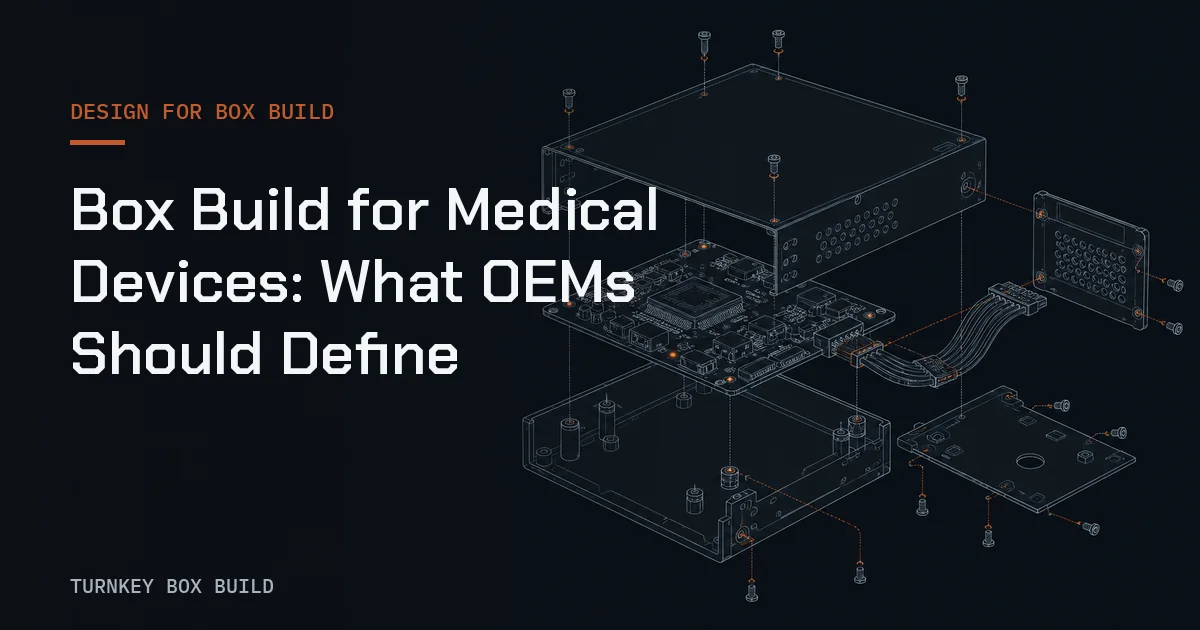
Box Build for medical devices usually combines a released enclosure, PCBAs, cable assemblies, controls, software configuration, labels, and product-specific verification into a finished or partially finished device. The difficult part is not the list of components. It is defining how design intent becomes controlled assembly evidence without confusing a manufacturing record with proof of regulatory compliance.
The OEM owns the product design, intended use, risk decisions, regulatory strategy, and acceptance criteria. Product-level medical compliance, including ISO 13485, FDA, and IEC 60601 obligations where applicable, remains the customer’s responsibility. We record the assembly and verification evidence agreed for the project; those records do not independently establish product compliance.
Define the exact Box Build boundary
Start by naming the incoming and outgoing states. An incoming PCBA may already be accepted, or it may require identity and condition checks before integration. The outgoing unit might be mechanically complete, configured and tested, labeled for the next operation, or packed for shipment. Each interpretation changes the required route and records.
Use a responsibility matrix covering design authority, approved sources, supplied material, tooling, firmware, test development, release approval, nonconformance decisions, and record retention. The overview of what Box Build assembly includes helps separate integration from upstream component manufacture. The electromechanical assembly capability gives a useful view of the physical interfaces that need definition.
Connect manufacturing inputs to design controls
Medical device design controls belong to the OEM’s quality and regulatory framework. The Box Build package should identify which released outputs govern manufacturing: bills of materials, drawings, specifications, risk-control requirements, software identifiers, test methods, labeling, and packaging instructions. Manufacturing should not infer a requirement from an obsolete model or informal email.
A practical release index lists each document, revision, status, and owner. It also states which source governs if a model, drawing, or bill of materials disagrees. Open design questions should remain visible until the OEM approves a resolution through its change process.
Specify DHR evidence rather than asking for “full documentation”
A device history record, or DHR, is the collection of production evidence the OEM requires to show that a device or batch followed the applicable device master record. The OEM should define which Box Build records feed that history and in what form.
| Evidence group | OEM decision to define | Possible Box Build record |
|---|---|---|
| Product identity | Unit, batch, and revision relationship | Serial or lot-linked traveler |
| Material status | Which inputs need lot or serial links | Approved material capture |
| Assembly | Required operations and signoffs | Controlled route completion |
| Configuration | Approved firmware and options | Configuration verification result |
| Acceptance | Test method and pass criteria | Original result and disposition |
| Exceptions | Approval authority and closure | Nonconformance or rework reference |
“Possible” matters here. The OEM selects the evidence needed for its product; the manufacturer should not invent a universal DHR template and assume it satisfies every device program.
Design traceability and serialization around risk
Serialization gives a unit a unique identity. Traceability connects that identity to relevant materials, revisions, process events, tests, rework, and shipment information. The required depth depends on the OEM’s risk analysis and investigation needs.
Define serial ownership, format, duplicate prevention, label verification, reprint control, and the treatment of scrapped identities. Then identify which components need unit-level links, which can be controlled by lot, and which only need verification against the released bill of materials. The Box Build traceability and serialization guide provides a field-by-field decision framework.
Translate risk controls into assembly instructions
If assembly implements a product risk control, the instruction and evidence need an explicit connection to that requirement. Examples may include a protected routing zone, a grounding contact, a locking feature, a specific orientation, software selection, or a final functional response. The OEM defines the requirement and acceptance condition.
Work instructions should show sequence, orientation, referenced parts, tool method, inspection points, product protection, and escalation rules. Visual clarity is useful, but a photograph cannot replace a controlled dimension or approved acceptance criterion.
Define clean or controlled environment requirements
Cleanliness and environmental controls are product-specific inputs, not assumptions attached to the word “medical.” The customer must define any required clean or controlled environment, particulate or bioburden controls, gowning, material restrictions, cleaning method, monitoring, handling, or packaging condition.
Those requirements should enter the RFQ as measurable specifications with an approval and evidence path. A supplier should confirm feasibility against the stated need and identify any qualified external support. No one should imply cleanroom capability or a particular environmental classification without verified, applicable evidence.
Separate manufacturing tests from product compliance
Box Build verification can check assembly workmanship, connection, configuration, safety interlocks, selected functions, and labeling when the OEM provides approved methods and limits. It does not replace design verification, electrical safety evaluation, software validation, usability work, or other product-level compliance activities.
Define the unit configuration, fixture and software revisions, steps, expected responses, limits, retained values, failure state, retest rules, and approval authority. The functional test plan guide explains how to make manufacturing acceptance repeatable without overstating its meaning.
Preserve change control through production
Changes to parts, drawings, firmware, labels, instructions, fixtures, tests, or suppliers may affect product risk and regulatory documentation. The OEM should define notification, review, approval, effective date, inventory disposition, and verification requirements before production begins.
Temporary deviations need the same clarity. Record affected units, approved scope, duration, extra checks, and closure. A technically acceptable substitution is not authorized until the designated product authority approves it.
Put the medical device requirements into the RFQ
The RFQ should include the release index, responsibility matrix, applicable design outputs, traceability map, required DHR evidence, environmental requirements, test boundary, exception workflow, change-control rules, and retention expectations. Mark unknowns openly so engineering work is not hidden inside a production assumption.
Review Box Build versus electromechanical assembly when deciding how much configuration, testing, and documentation belongs in the scope, and see how the integration scope is organized on our medical device enclosures build page. Then use the RFQ checklist to organize the package. When the boundary and evidence are ready, request a quote and ask for a medical device Box Build scope review before releasing material or production instructions.
Before release, map the required records to the site’s quality and traceability framework and confirm that serial application, verification, and reprint controls fit the labeling and serialization flow. Those pages describe manufacturing controls; the OEM still determines which controls and regulatory obligations apply to the device.